86-592-5659128 (to8016)
anna@xmydx.com English
 Deutsch
 español

20 YEARS Silicone manufacturer
86-592-5659128 (to8016)
anna@xmydx.com
20 YEARS Silicone manufacturer



2026-11-06
Short answer: A custom silicone baby feeding product typically samples in 3–7 days and produces in 5–30 days, with MOQ from 100–2,000 pcs per colour. Two things decide whether the product can be sold at all: the compliance evidence pack and the suction base. A plate that slides across the table is a safety complaint; a plate without the right certificate is a shipment that does not clear the retailer's compliance desk.
This guide covers the product set, how the suction base actually works, what the US and EU each require, and where the cost sits.
• This is a compliance-first category. A recall costs more than the entire programme; build the evidence pack before the tooling.
• The US and EU do not accept the same documents. FDA food-contact plus a Children's Product Certificate in the US; food-contact plus EN 14372 in the EU.
• Suction performance is a design parameter, not a feature claim. Skirt thickness, base ring stiffness and table finish all matter.
• Soft-tip spoons are a different compound — typically 30–50 Shore A — and should be specified separately from plates and bibs.
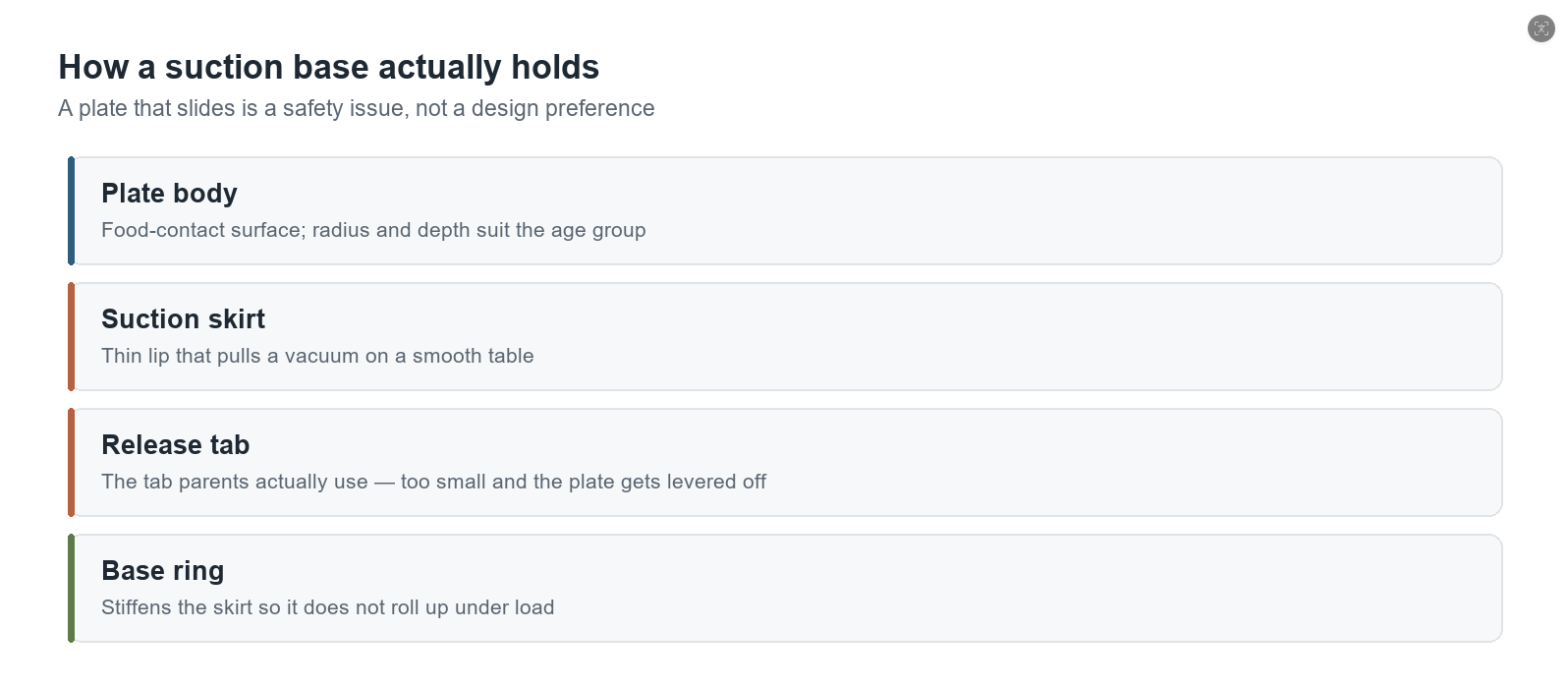
Figure 1. Four features control whether the plate stays put.
A houseware product that fails gets returned. A baby product that fails gets reported, and the cost is not the unit — it is the recall, the retailer chargeback and the listing suspension.
That changes the order of work. In most categories you design, quote, sample, then handle compliance. Here, the compliance route determines the design: which markets, which tests, which claims on the packaging, and which documents the retailer will demand before they will even look at a sample.
Practical rule: decide the destination markets first, then design, then tool.
|
Product |
What it has to do |
Design pressure |
|
Suction plate / bowl |
Stay on the table, release on demand |
Skirt geometry, base ring stiffness, release tab size |
|
Catch-pocket bib |
Hold spilled food without collapsing |
Pocket rigidity versus comfort at the neck |
|
Soft-tip spoon |
Be gentle on gums, stiff enough to load |
Tip hardness, handle rigidity, length |
|
Training cup |
Survive dropping and tipping |
Wall thickness, lid retention, handle attachment |
Most brands start with a plate and a bib, then extend. The set has to look coherent — same colour family, same surface finish — which is a colour-matching problem across four tools, not one.
|
Feature |
Function |
Design note |
|
Plate body |
Food surface |
Depth and radius should match the age group; too deep and the spoon cannot reach the corner |
|
Suction skirt |
Pulls a vacuum on a smooth surface |
Too thin and it rolls; too thick and it will not seal |
|
Release tab |
Lets the parent break the seal |
Too small and the plate gets levered off — which is how most plates break |
|
Base ring |
Stiffens the skirt |
Without it, the skirt deforms under load and loses vacuum |
The counter-intuitive part: more suction is not always better. A plate that grips too hard gets pulled by the rim, food goes everywhere, and the parent blames the product. The design target is enough hold to survive a determined toddler, and a release tab the adult can actually use one-handed.
Surface finish matters too. Suction only works on smooth, non-porous surfaces — a textured or matt table defeats it, which is why the packaging should state the compatible surfaces rather than claim a universal hold.
Plates, bibs and spoons should be platinum-cured, filler-free and post-cured. Peroxide-cured compounds are cheaper and can carry odour, which in a baby product is not a cosmetic issue.
Two claims worth getting right:
• "BPA-free" is a property, not a certificate. Pure silicone contains no bisphenol A. A "BPA-free certificate" for silicone proves nothing; the migration report is what counts.
• "Food grade" is not a market approval. It describes a material that meets food-contact requirements, tested on the finished article.
Figure 2. Two markets, two document sets — most brands need both.
• FDA 21 CFR 177.2600 food-contact testing on the finished part
• CPSIA compliance: a Children's Product Certificate (CPC) supported by third-party testing
• Lead limits for substrate materials and the restricted phthalate limits — both are pass/fail gates, not marketing points
• Age grading and small-parts review, because a release tab or a valve can become a choking hazard if it detaches
• Food-contact testing under the EU framework for silicones, with BfR Recommendation XV as the usual reference
• EN 14372 — the safety standard for child use and care articles, cutlery and feeding utensils
• REACH restrictions, and destination-country labelling requirements
A US retailer will not accept an EU report, and an EU retailer will not accept a CPC. Budget for both if you sell in both.
1. Overall migration — the food-contact baseline
2. Volatile organic compounds — the odour and taint risk
3. Sensory — taste and smell after the specified conditioning
4. Suction force — measured on a defined surface, wet and dry
5. Drop — from a defined height, on a hard floor, checking for cracking at the base ring
6. Dishwasher and sterilisation cycles — then re-test suction and colour
7. Small parts — pull test on the release tab and any valve
• Compliance testing — a fixed cost per SKU and per market, and it does not scale down with order size
• Tooling — plate, bib, spoon and cup are separate tools
• Colour — baby ranges usually carry four to six colours, each with a minimum run
• Packaging — retail box, insert and often a gift-ready format
• Order quantity — small brands often start at 500–1,000 pcs per colour, where tooling and testing dominate the unit price
This is why the first order in this category is rarely the cheapest per unit, and why brands that succeed usually launch one colourway, prove the listing, then extend.
What is the MOQ for custom silicone baby feeding products? MOQ typically runs from 100 to 2,000 pcs per colour. Compliance testing is a fixed cost per SKU, so the effective minimum for a new brand is usually set by the test budget rather than by the moulding.
How long does sampling and production take? Sampling is 3–7 days for silicone parts; a full set with colour matching may need a second round. Production runs 5–30 days. Compliance testing runs on a separate timeline and should be scheduled in parallel, not after.
Do I need both FDA and CPSIA for the US? Yes, for a children's feeding product. FDA covers food contact; CPSIA covers the children's-product requirements and is evidenced by a Children's Product Certificate supported by third-party testing.
Is EN 14372 mandatory in the EU? It is the recognised safety standard for cutlery and feeding utensils, and EU retailers will ask for it. Food-contact compliance is separate and also required.
Can the plate go in the dishwasher and be sterilised? Most food-grade silicone handles dishwasher cycles and boiling water. Steam sterilising at higher temperature should be checked against the specific compound's rating — do not assume it from the category.
Can you make a custom shape, a divided plate or a branded bib? Yes. Divided plates need a thicker base and a different tool; bibs can carry an embossed logo or a printed neckline label. Confirm which surface carries the brand before tooling.
About Xiamen Yidexin Silicone Rubber Industrial Co., Ltd. Founded in 2004 in Xiamen, China, Yidexin moulds custom silicone houseware, baby products and OEM parts, including food-contact and baby-care parts in platinum-cured compounds. The factory runs 10 production lines with 50+ QC staff; total staff 109, including 5+ certified engineers. Intertek onsite verified in January 2026. Hardness range 20–80 Shore A; MOQ 100–2,000 pcs; sampling 3–7 days for parts. See baby supplies or send your drawing.
2F/YISHENG BUILDING,1ST INDUSTRIAL ZONE,DIANQIAN,HULI DISTRICT,XIAMEN CITY,CHINA
86-592-5659128 (to8016)
+86-592-5785493
+86-13850076578
© 2016 XIAMEN YIDEXIN SILICONE RUBBER INDUSTRIAL CO.,LTD All Rights Reserved dyyseo.com
Online Contact
 86-592-5659128 (to8016)
 anna@xmydx.com
 +8613606037597+8613850076578
top