86-592-5659128 (to8016)
anna@xmydx.com English
 Deutsch
 español

20 YEARS Silicone manufacturer
86-592-5659128 (to8016)
anna@xmydx.com
20 YEARS Silicone manufacturer



2026-11-06
Short answer: A custom silicone baking mat typically samples in 3–7 days and produces in 5–30 days, with MOQ from 100–2,000 pcs depending on size, coating and packaging. Three specifications decide whether the mat survives a commercial oven: coating weight, the fiberglass core and the edge finish. A mat that skips the core looks identical on day one and curls at 200 °C by month three.
This guide covers how the mat is built, which formats sell where, what belongs in a specification, and why two quotes for the same drawing can differ by a factor of three.
• The fiberglass core does the structural work. Silicone alone creeps under heat and load; the woven core is what keeps the mat flat and dimensionally stable.
• Coating weight is the main cost and durability lever — more silicone means better non-stick life and a higher price, not a thicker mat.
• 0.4–0.8 mm covers most retail mats; printed pastry mats run thicker because of the print layer.
• Most food-grade compounds are rated to about 230 °C / 450 °F. Ask for the rating of the specific compound, not the category.
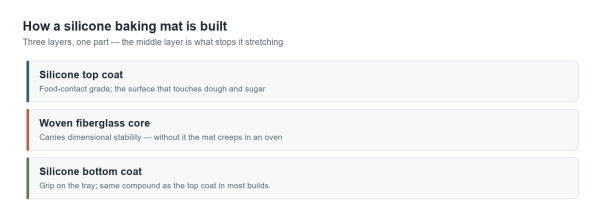
Figure 1. Two silicone coats around a woven core — the middle layer is what stops the mat stretching.
Parchment is bought by the roll and thrown away by the tray. A silicone mat is bought once and used hundreds of times, which changes the cost calculation completely at any real volume.
Three reasons the switch holds:
• Cost per use. A mat that survives 500 bake cycles costs a fraction of the same number of parchment sheets, even at a higher unit price.
• Better heat transfer. Silicone conducts heat more evenly than paper, which reduces the pale-ring problem on the base of bread and pastry.
• No adhesive residue and no curl. Parchment curls at the corners as it ages; a cored mat stays flat.
What a mat does not do is replace a non-stick tray that has already failed. The mat protects the tray and provides the release surface; it does not repair a warped pan.
|
Layer |
What it does |
Specification note |
|
Silicone top coat |
Food-contact surface and release layer |
Coating weight, cure system, colour |
|
Woven fiberglass core |
Holds dimensions; prevents creep and stretch |
Mesh weight and weave density |
|
Silicone bottom coat |
Grip on the tray; balances the build |
Usually the same compound as the top |
The core is the part buyers forget to specify. A mat quoted without a stated mesh weight is a mat whose stiffness is uncontrolled — and stiffness is what keeps a 600 mm mat from bowing when it is lifted with a tray of dough on it.
Edge finish matters for the same reason. A cut edge exposes the core; a sealed or rolled edge does not. On a commercial mat, the edge is where delamination starts.
|
Format |
Typical thickness |
Buyer |
What to watch |
|
Solid mat |
0.4–0.8 mm |
Supermarkets, private label, bakeware brands |
Price competition; coating weight is the differentiator |
|
Perforated mat |
0.4–0.8 mm |
Bread and pastry producers |
Hole pattern must be tooled, not punched after curing |
|
Printed pastry mat |
1.0–2.0 mm |
Home baking, gifting, measurement-marked mats |
Print step adds cost and a colour-matching risk |
|
Grill / toaster mat |
0.3–0.5 mm |
BBQ brands, small appliance makers |
Cut-to-size; edge sealing becomes critical |
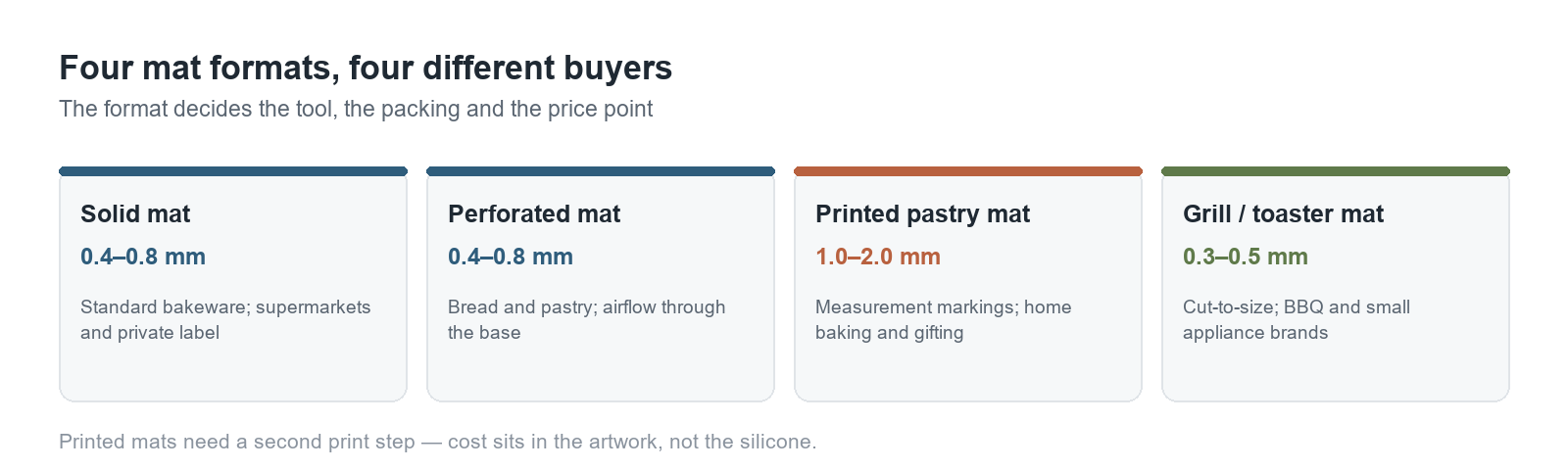
Figure 2. Format drives the tool, the packing and the price point.
Printed mats are the odd one out commercially: the silicone is a commodity, and the value sits in the artwork. That means a print proof, a colour standard and a registration check on the first article — not just a dimensional report.
Coating weight is quoted in grams per square metre and is the single biggest lever on both cost and service life. A heavier coat releases better and lasts longer; a lighter coat is cheaper and reaches its end of life sooner. Specify it, or accept whatever the factory runs that week.
Thickness follows from coating weight plus core. A ±0.05 mm tolerance is realistic on a cored mat; a ±0.02 mm call-out on a 600 mm part usually means the supplier will either decline or fail the first article.
This is the test that separates a real mat from a lookalike. Bake the sample at the rated temperature for a defined cycle, cool it, and measure again. A cored mat returns to its dimensions; an uncored one grows and stays grown.
Most food-grade silicone handles about 230 °C / 450 °F continuously. Above that, degradation shows up as staining, then as a loss of release, then as cracking. If a customer intends to use the mat under a broiler, that is a different product, not a different claim.
Sealed edge, rolled edge or cut edge. Sealed is standard for retail; rolled is better for heavy commercial use; cut is acceptable only on small mats where the core is encapsulated by the coating.
1. Coating adhesion — bend and inspect for separation at the edge
2. Dimensional stability — bake, cool, re-measure
3. Colour and gloss — against the approved standard, under defined light
4. Odour after cure — sensory check before packing
5. Edge integrity — no exposed core, no fraying
6. Print registration — on printed mats, first article and last article of the run
• Coating weight — the largest material driver
• Core mesh — a heavier weave costs more and stiffens the mat
• Size — a 400 × 600 mm half-sheet mat is the volume format; oversize mats need wider lines
• Print or emboss — a second process, a colour standard and a proof cycle
• Packaging — a rolled mat in a colour box costs more to pack than a flat mat in a sleeve
• Order quantity — below about 2,000 pcs, tooling and setup dominate
What is the MOQ for a custom silicone baking mat? MOQ typically runs from 100 to 2,000 pcs depending on size, coating weight and whether new tooling or printing is required. Standard half-sheet mats in stock colours start lowest.
How long does sampling take? Sampling is usually 3–7 days for silicone parts; printed mats need a proof cycle on top of that. Production runs 5–30 days depending on quantity and print scheduling.
What is the maximum temperature? Most food-grade silicone compounds are rated to about 230 °C / 450 °F. Ask for the rating of the specific compound supplied, and do not treat the category as a guarantee.
Can the mat go in a dishwasher? Yes, for retail mats with a sealed edge. Commercial dishwashers run hotter and more alkaline than domestic machines, so specify the wash cycle if the mat is going into food service.
Can you print measurements or a brand logo? Yes. Printed mats carry a measurement grid, a logo or both. Logo-only printing is cheaper than a full grid because there is less ink coverage and a simpler proof.
Is a silicone mat better than parchment paper? For repeated use, yes — cost per use, even browning and no curl. For a one-off bake or a very high-temperature roast, parchment is still the simpler choice.
About Xiamen Yidexin Silicone Rubber Industrial Co., Ltd. Founded in 2004 in Xiamen, China, Yidexin moulds custom silicone houseware, baby products and OEM parts. The factory runs 10 production lines with 50+ QC staff; total staff 109, including 5+ certified engineers. Intertek onsite verified in January 2026. Hardness range 20–80 Shore A; MOQ 100–2,000 pcs; sampling 3–7 days for parts. See household supplies or send your drawing.

2F/YISHENG BUILDING,1ST INDUSTRIAL ZONE,DIANQIAN,HULI DISTRICT,XIAMEN CITY,CHINA
86-592-5659128 (to8016)
+86-592-5785493
+86-13850076578
© 2016 XIAMEN YIDEXIN SILICONE RUBBER INDUSTRIAL CO.,LTD All Rights Reserved dyyseo.com
Online Contact
 86-592-5659128 (to8016)
 anna@xmydx.com
 +8613606037597+8613850076578
top